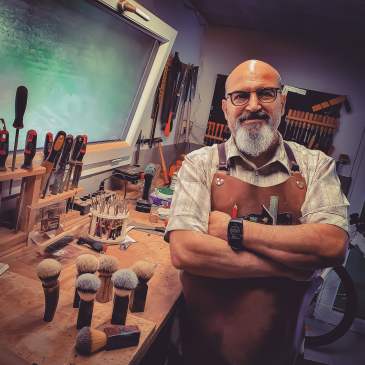
Introducing myself and my artisan production of handmade shaving brushes. I’m an agronomist and mechanical engineer, living in Bologna since 2010. I was born and raised in Frankfurt, Germany.
I’m a passionate wetshaver – my favourite tools are Kamisori and straight razors (mainly Japanese blades). This passion brought me to deepen a lot of aspects of wet shaving culture – first of all the artisan work in this passion!
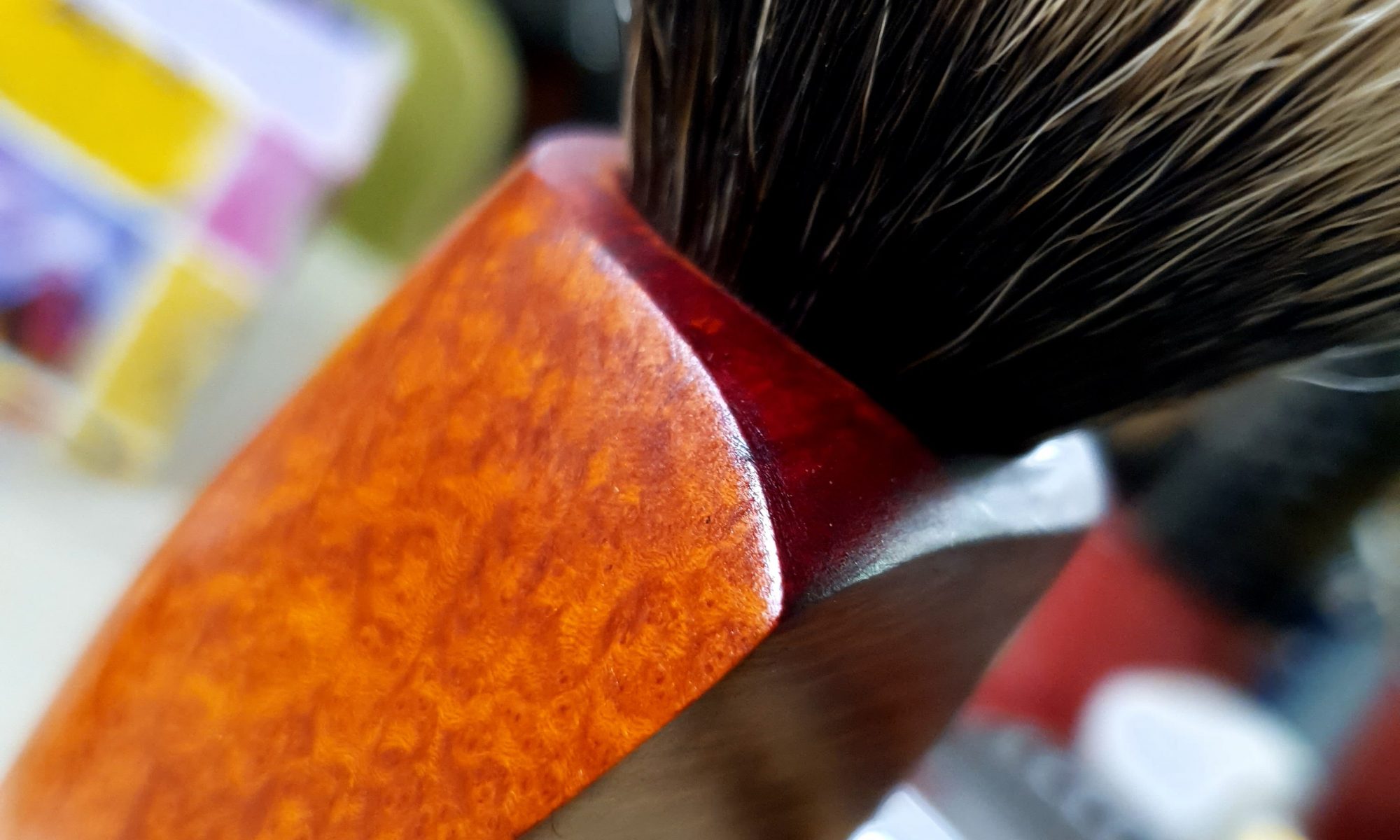
Because that’s how I see my work – a craft product made by a person who has a great desire to learn and tries to do so every day. I use saws, rasps, files, chisels, gouges, mallets and sandpaper in making my free hand brushes. I admit … the hole for the knot is made with a hypertechnological photon plasma laser drill. Beside the free hand brushes I make also turned brushes – mainly burls enriched with epoxy resin. And I try always to deliver a coordinated bowl.
Here we are then – making brushes – how come?
Passion for traditional shaving? Of course… !
From the restoration of straight razors and then Kamisori always looking for the ultimate edge. But the ‘creative’ process for me ended there – the Hamletic doubt about synthetic or natural stones … I’m not good at making straight razor handles (I broke many of those cheeks by replacing the pins) – maybe that’s why I preferred to work with Kamisori.
Passion for woodworking? Definitely …!
Working it conveys the particular feeling of handling a “living” material.
In my work I use only Italian wood from Calabria (olive, oak, chestnut, briar, mulberry) and from the Tuscan-Emilian Apennines (elm, cherry, pear, apple, red beech, walnut, plum). The owners of the small sawmills in my area are also woodcutters – they have stories to tell, about every tree and every piece of wood. It’s always worth listening to.
The search for absolute beauty, the awareness of subjective beauty and the concept of aesthetics? Always …!
Absolute beauty by definition is not subjective – it is a myth of modern individualism. There are ‘rules’ and ‘canons’ that determine harmony and symmetry that are widely discussed by most of the classical philosophers. Although in everyday life beauty is often used to refer to aesthetic taste, it is an abuse of language.
The processed wood reproduces drums and sections of branches following the intrinsic shapes of the wood itself. The work has led me to follow the sinuous forms and not to force them into unnatural, overly balanced architectures.
A warm greeting from Italy
Raffaele
 Pennelli Talarico